
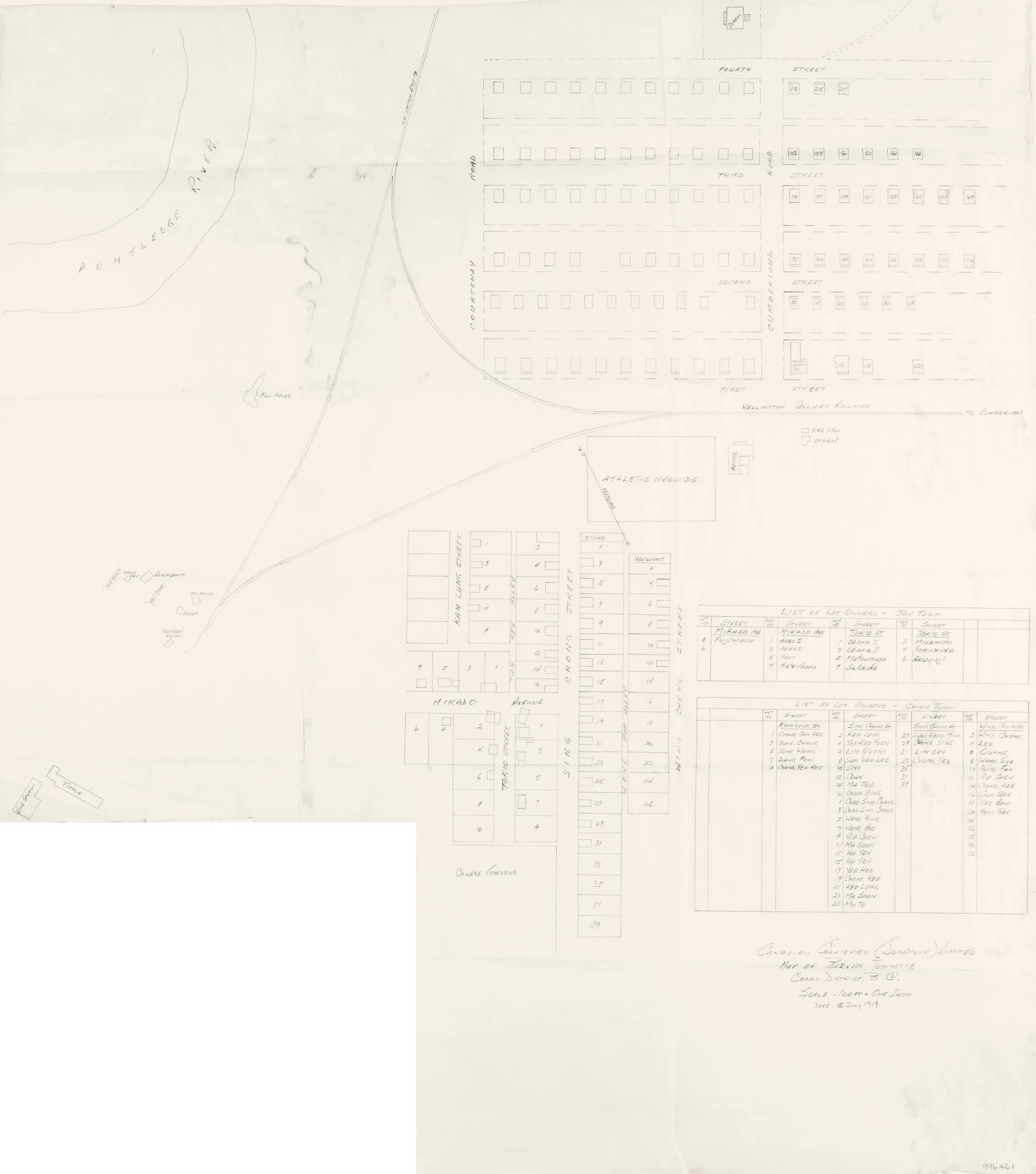
Original map of Bevan Townsite, 1919
Type: Document
Date: 15 July 1919
History
This map shows the Chinese and Japanese Canadian communities of the original townsite of Bevan. The lots are numbered and the owners of the lots are listed according to street number. Also of note is the building labelled “Hotel” which refers to the Bevan Hotel.
The town of Bevan was constructed in 1911 by the Canadian Collieries (Dunsmuir) Ltd. to serve and house the workers of the No. 7 and No. 8 mines. The town was also home to loggers from the Comox Logging and Railway Company.
Bevan's heyday was short-lived, however. By 1918 coal production was on the decline, and as work moved elsewhere many of the town residents left and many of the 150+ houses were removed and relocated to Cumberland to house workers there instead. Bevan’s Chinese and Japanese communities remained, on the opposite side of the railway from the town, until a fire in 1922 destroyed them. Eventually what was once the town of Bevan dwindled down to just a few buildings, until in 1995 the last building from old Bevan, the Bevan Hotel, was torn down.
The map is missing a section of its bottom left side.
Description
1 map: white. 100 ft = 1 inch.
Item Details
- Materials: paper (fiber product)
- Classification: Category 8: Communication Objects > Documentary Objects > Graphic Documents > cartograph > map
- Accession Number: 996.042.001
- Author: Canadian Collieries (Dunsmuir) Ltd.
- Donor: Martin, John
- Donated: 1996-09-17
- Size: 73 x 76 cm
- Credit: Digitized with the assistance of the British Columbia History Digitization Program and the Canadian Heritage Museums Assistance Program. Thank you for your support.


